2025 Legislative Primer.

The 2025 Louisiana Legislative Session begins Monday, April 14, 2025. Insurance is again at the forefront, but this time Commissioner Temple and his legislative allies are focused on auto insurance. Temple is touting a package of bills that promise to further stack the deck in favor of big insurance at the expense of Louisiana policyholders.

Here is an overview of Louisiana's insurance crisis and the industry's continued efforts to profit off of policyholders' pain. 
Read Expert's Report on Louisiana Insurance Crisis

Competitiveness

Commissioner Temple has repeatedly stated that Louisiana's insurance market is non-competitive. To attract more insurance companies to Louisiana, Temple wants to pass legislation that guts policyholders' rights and benefits insurers.


However, an industry expert and former Missouri Insurance Commissioner recently testified before the Louisiana legislature, stating that the structure and number of companies participating in Louisiana's personal auto insurance market "is squarely in the national mainstream."


Click here to read more about the competitiveness of Louisiana's auto insurance market.


Profitability

Commissioner Temple and his legislative allies have repeatedly suggested that insurers in Louisiana are struggling to turn a profit. However, the data suggests otherwise.


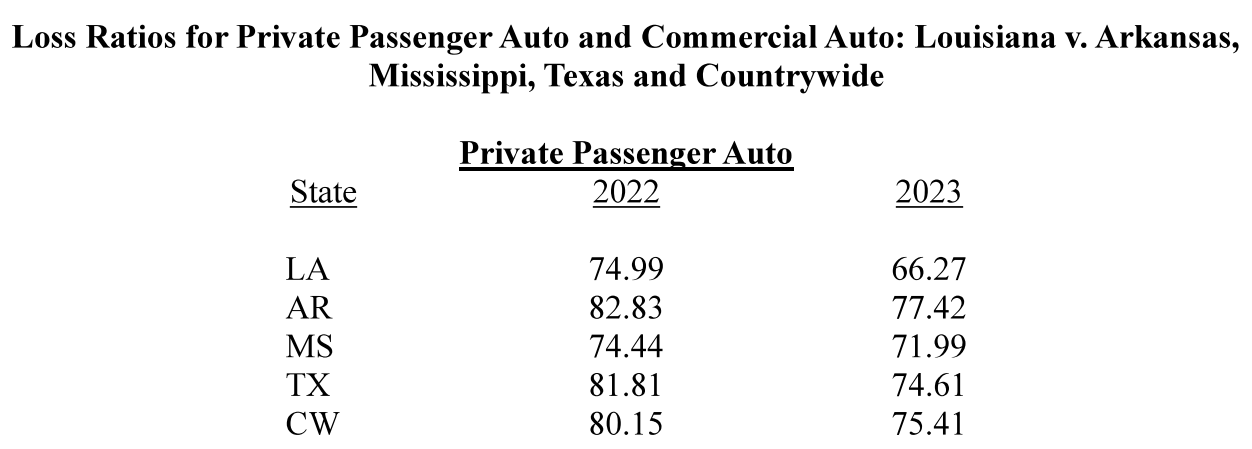
Insurers do not report their profits. Instead, they report loss ratios, which are proxies for profit. Loss ratios show the percentage of losses an insurance company pays out compared to the premiums it collects. The lower the ratio, the more the profit.


Louisiana personal auto insurance loss ratios were 9% better than the national average in 2023, and at least 5% better than each of our neighboring states: Arkansas, Mississippi, and Texas. These strong profit margins are largely driven by the fact that insurers in Louisiana collect among the highest premiums in the nation.


Click here to read more about the profitability of Louisiana's auto insurance market.

Why are rates so high if the market is competitive and insurers are making a profit?

According to expert testimony before the Louisiana legislature, high insurance rates in Louisiana are due to severe weather and industry-friendly lax regulations.


Louisiana law allows the commissioner to reject a rate for being too low, but it does not grant the commissioner sole authority to reject a rate for being excessive. In fact, Commissioner Temple testified that it is not the role of the Department of Insurance to determine whether rates are excessive.


According to testimony, some of the rates insurers filed with the Louisiana Department of Insurance included "really, really high" profit factors. Not surprising when you recall that Commissioner Temple repealed profit caps on rates filed by insurers with the State of Louisiana.


These findings are consistent with a Harvard School of Business report that found “higher [insurance] premiums are being charged in states where regulators apply less scrutiny to requests for rate increases.”


Click here to read more about how lax regulation contributes to high rates in Louisiana.

Why is Commissioner Temple and Big Insurance pushing Florida's failed model?


Florida has the highest property and auto insurance rates in the nation. Florida auto insurance rates have increased 42% since 2022, when the pro-industry package passed. Since the passage of these bills, we have seen:


By Ben Riggs March 13, 2026
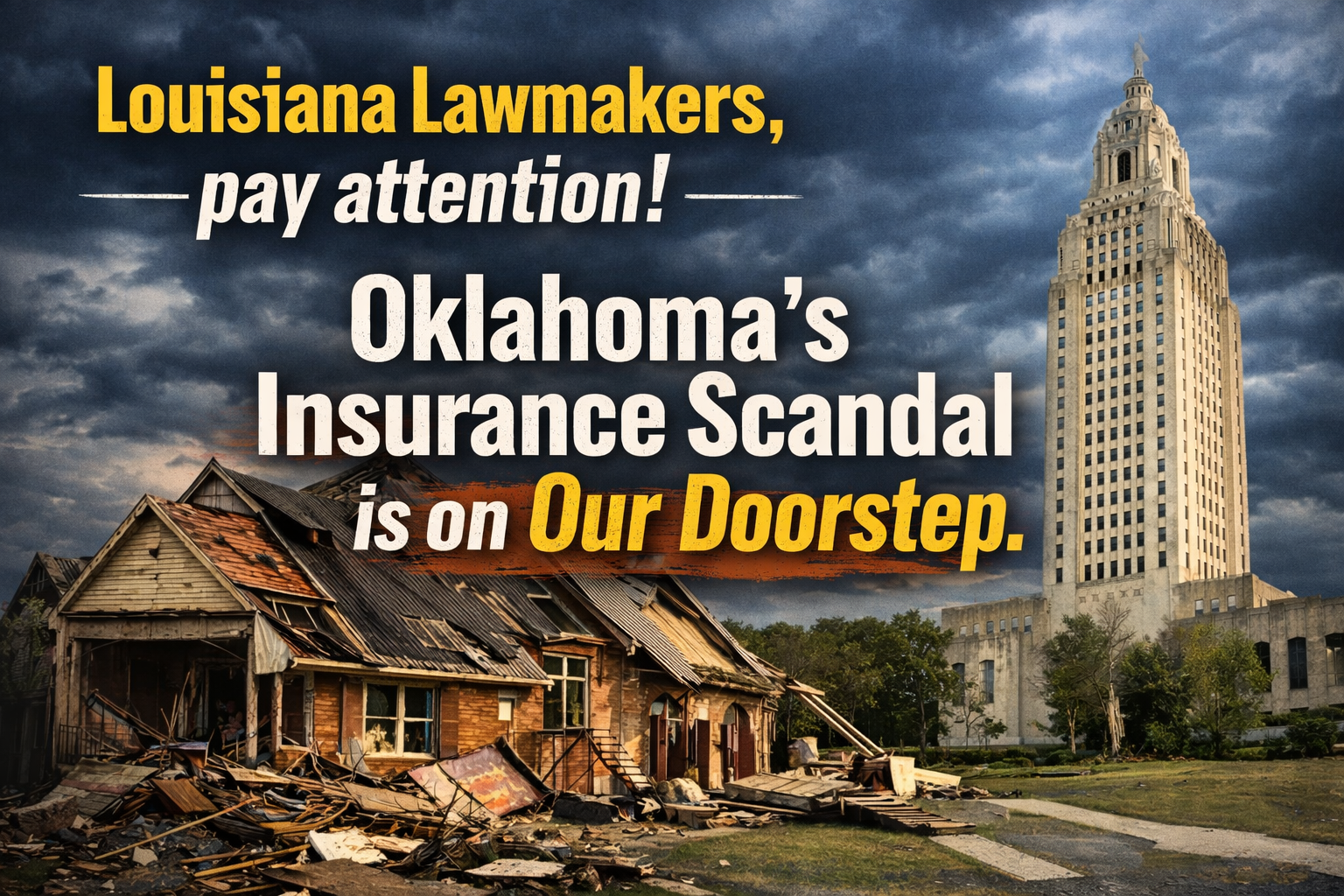
Oklahoma's lawsuit should get Louisiana lawmakers’ attention. With Louisiana’s legislative session underway and insurance top of mind, a major lawsuit filed in neighboring Oklahoma should raise serious questions for lawmakers concerned about the insurance industry’s conduct here at home. Republican Oklahoma Attorney General Gentner Drummond has filed a lawsuit accusing State Farm of using internal practices designed to systematically reduce payments to homeowners with legitimate storm damage claims. The lawsuit alleges the company collected premiums from policyholders while minimizing what it paid out when those same customers filed claims. Attorney General Drummond described the alleged conduct in stark terms: “What we have here is what I believe is an intentional scheme to defraud customers… a scheme of deception.” The case centers on how claims were handled after severe storms damaged homes across Oklahoma. According to the lawsuit, company practices may have been used to reduce payouts to policyholders who relied on their insurance to repair storm damage. For Louisiana families—many of whom suffered through Hurricanes Laura and Ida—this story hits close to home. We already face some of the highest insurance costs in the country, and many homeowners report delayed claims, denied payments, or settlements that fall far short of what it takes to rebuild after severe storms. The same insurance companies operating in Oklahoma operate here. In fact, State Farm is the largest home insurer in Louisiana, covering roughly one-fifth of the market. That’s why transparency, accountability, and strong consumer protections matter more now than ever. What’s unfolding in Oklahoma is a warning Louisiana lawmakers gathered in Baton Rouge should take seriously—because what’s happening there is on Louisiana’s doorstep.
By Ben Riggs March 5, 2026
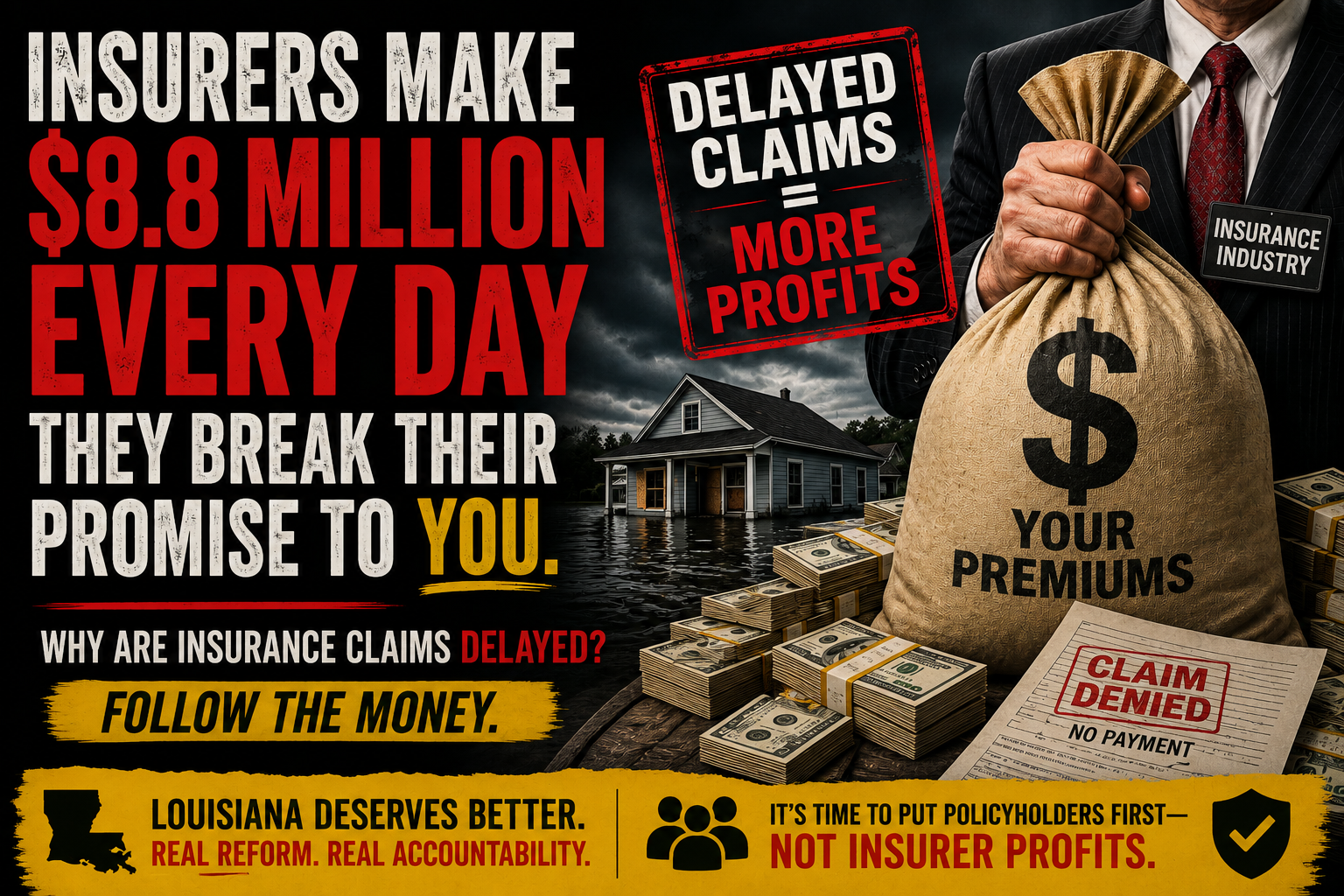
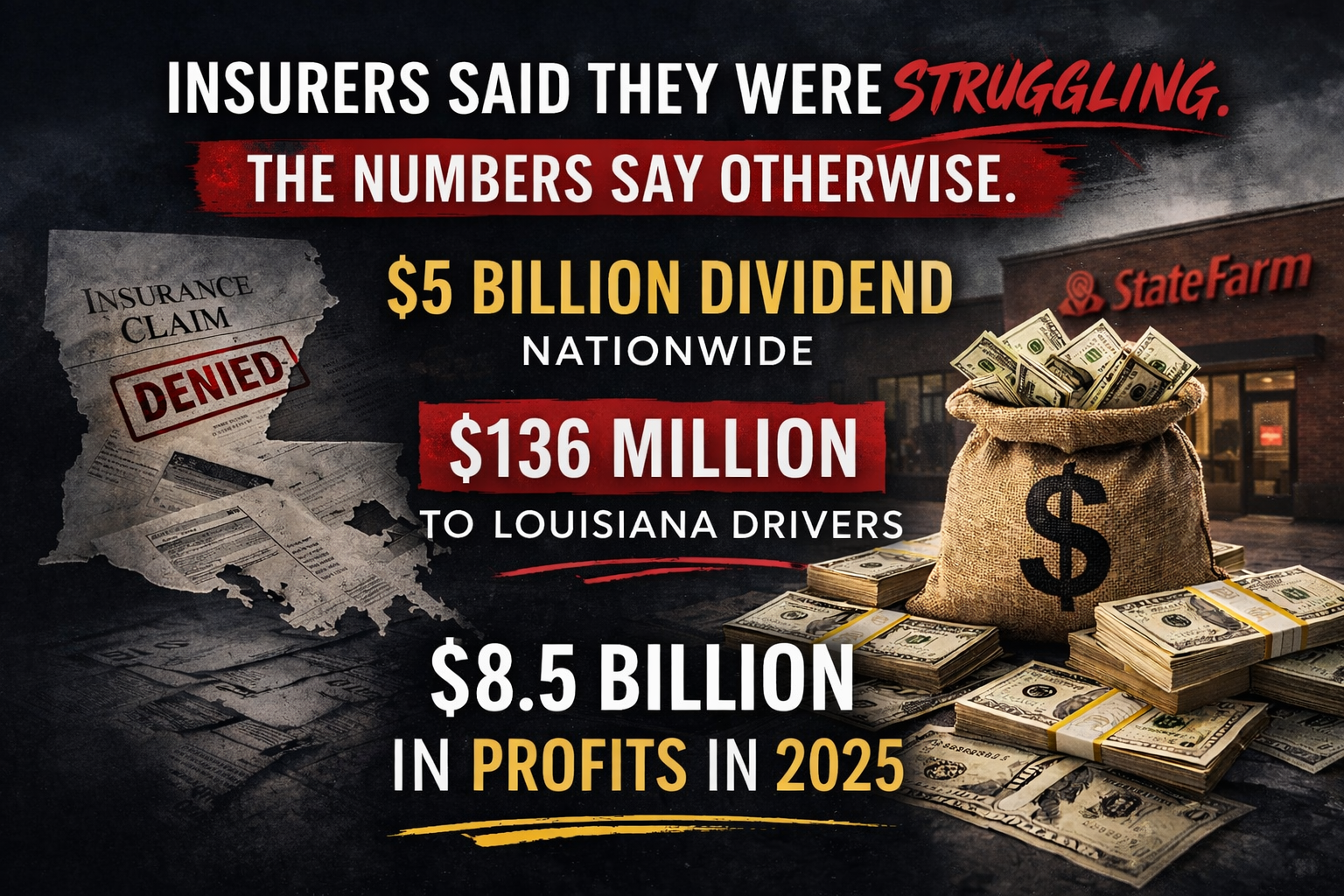
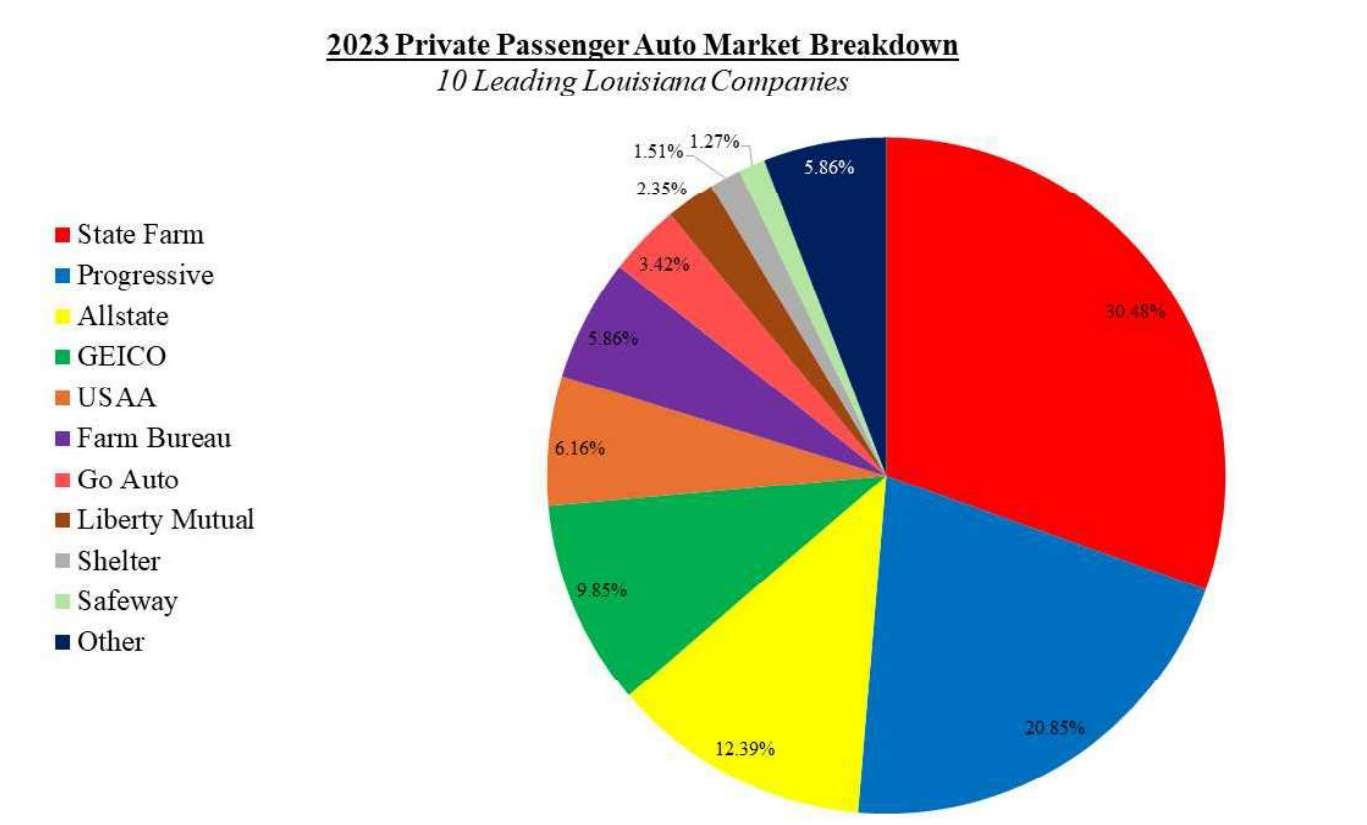
Big Insurance said they were struggling. The numbers tell a different story. For years, big insurance companies have told Louisiana families the same thing: the business climate here is “unfavorable.” They blamed consumers and the courts, claiming there were too many claims and too much litigation. And on that basis, insurers raised rates, restricted claims, and pushed to strip away consumers' legal rights. Now the truth is coming out. State Farm — the largest auto insurer in Louisiana, covering roughly 30% of the market — is paying out a $5 billion dividend nationwide. That includes $136 million back to Louisiana drivers , averaging about $138 per vehicle. We are happy that some of that money is going back to consumers, but why are they paying out a dividend? Because their underwriting profits were stronger than expected. In plain English, they collected WAY more in premiums than they needed to pay claims. In 2025 alone, State Farm reported $1.5 billion in underwriting profit . But here's the kicker: underwriting or selling policies isn't even the main way insurers make money. They make most of their profits by investing the premiums you pay for insurance. And in 2025, State Farm made another $7 billion from investments and other income . Struggling companies don't make $8.5 billion in profit in a single year — and they don't issue massive rebates. The insurance industry is not being crushed by an “oppressive environment” in Louisiana. They are doing very well. Louisiana families are being crushed by unaffordable insurance rates. And we deserve better. We deserve honesty. We deserve accountability. Louisiana families deserve rates based on facts — not fear. It’s time to stop protecting insurance company profits and start protecting policyholders.
March 3, 2026
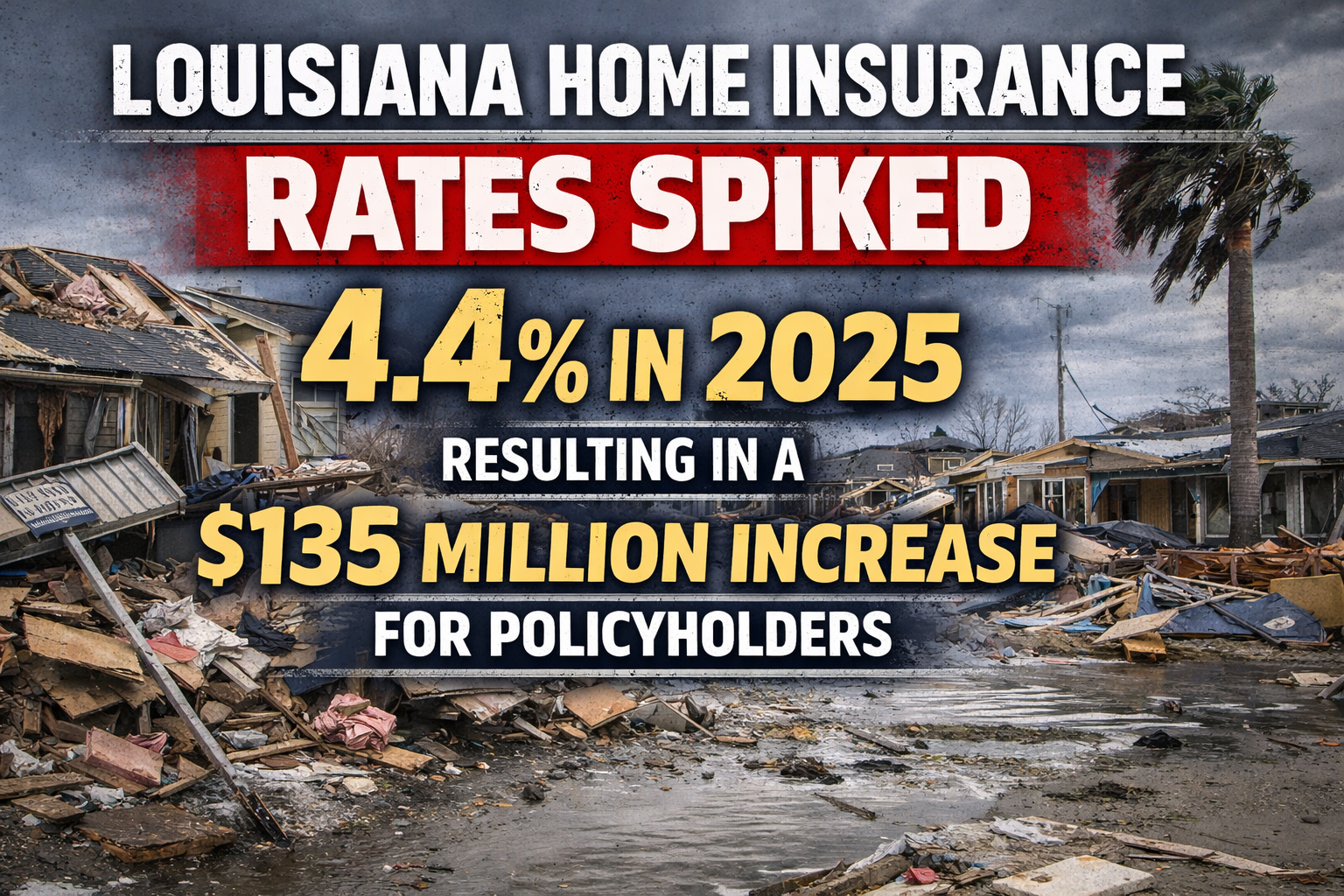
Why Property Insurance Rates Continue to Rise in Louisiana. Louisiana property insurance rates spiked by 4.4% in 2025 , resulting in a $135 million increase for policyholders statewide. Louisiana policyholders already pay the second-highest rates in the nation, at more than $3,800 above the national average. Why are property insurance rates continuing to climb in Louisiana? Because state regulators are ignoring the real problem. They are regulating the people of Louisiana, not the insurance industry. After Hurricanes Laura and Ida, 11 insurance companies collapsed — forcing stranded storm victims to go to court to recover what they were owed. Why did these companies go insolvent? Before the storms, those companies moved hundreds of millions of dollars off the books to unregulated affiliates, where they purchased executive perks like a $5.7 million hunting lodge. Their greed came first. Policyholders were an afterthought. While that was the most egregious behavior, other insurers routinely delayed and denied claims, sending victims through a maze of adjusters and paperwork. According to a 2022 survey by LSU , roughly half of all Louisiana residents were dissatisfied with how insurance companies handled property damage claims. Instead of demanding accountability from bad-faith insurers, Commissioner Temple has blamed storm victims at every turn. In a recent interview , Commissioner Temple chose to victim-blame Louisiana families. He said catastrophe-related litigation was a key driver in rising home insurance premiums, ignoring that the spike in litigation following the storms was due to bad-faith insurers failing to handle claims properly. In 2024, Temple declined to punish 17 shady insurers that generated an unusually high volume of complaints from policyholders after Hurricane Ida. Temple’s legislative packages have all focused on regulating the people of Louisiana by stripping away their legal rights, rather than the industry he was elected to regulate on their behalf. Commissioner Temple’s approach to Louisiana’s insurance crisis has made it harder for storm victims to file claims and easier for insurance companies to delay and deny claims, or cancel policies. Home insurers operating in Louisiana denied 44.6% of claims filed in 2024, according to Weiss Ratings . According to a recent poll , 85% of respondents say Louisiana’s insurance market is “poor” or “very poor.” Another survey shows that two-thirds of respondents saw a premium increase, roughly 50% struggled to find coverage, and approximately 1 in 10 reported having their policy cancelled by their insurer. Meanwhile , home insurers operating in Louisiana have invested your premium dollars to the tune of $88.3 billion and reported just $1.6 billion in underwriting losses, meaning they made $55 in profit for every dollar they lost. As a former insurance executive, Temple sees Louisiana’s insurance crisis through the lens of the insurance industry. Temple is blind to the plight of Louisiana policyholders. With the legislative session upon us, Louisiana policyholders need the legislature to step forward and pass common-sense laws that hold insurers accountable, strengthen consumer protections, and lower rates.
By Ben Riggs September 29, 2025
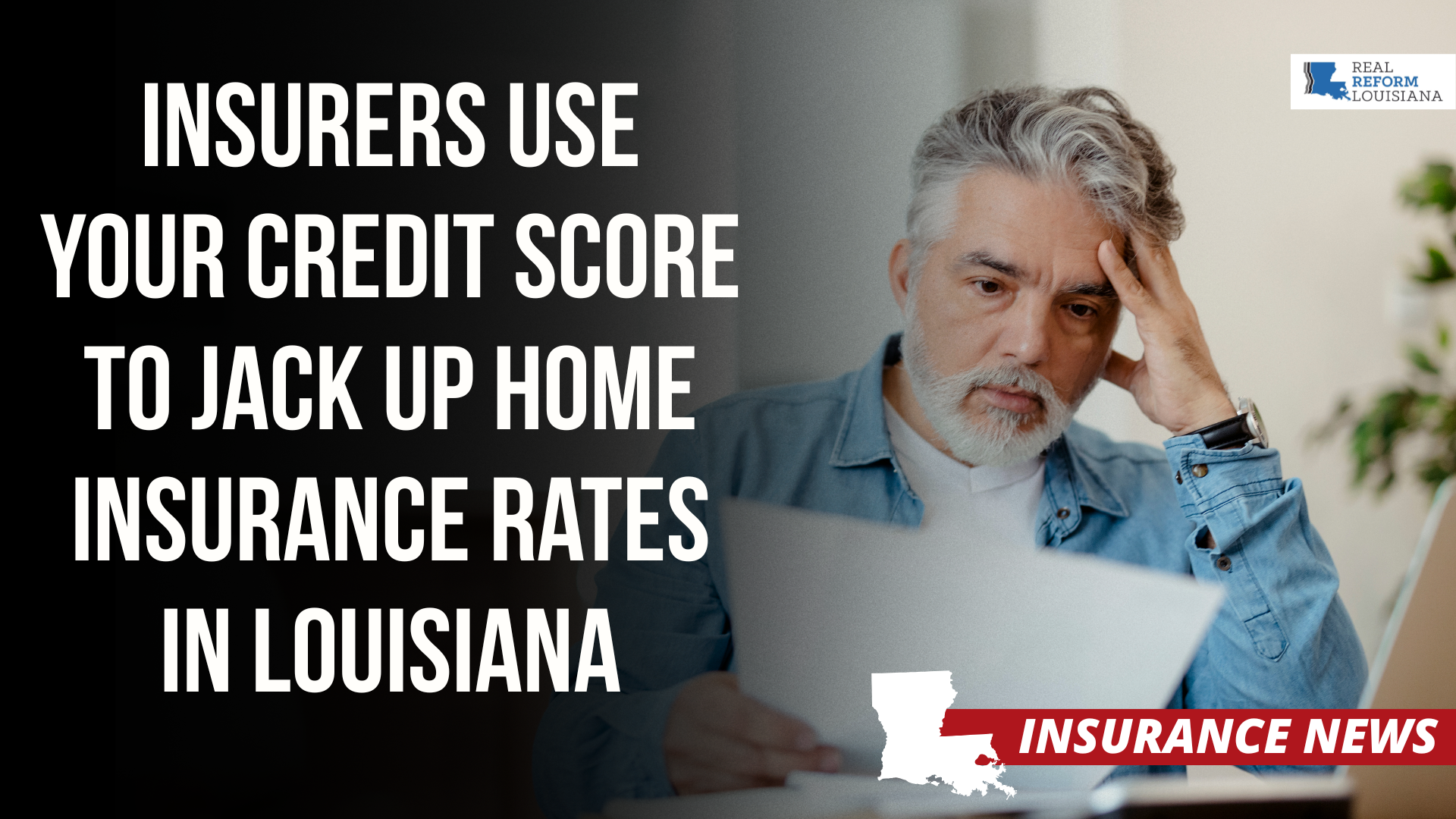
Credit penalties are jacking up home insurance rates that are crushing Louisiana policyholders. Year after year, the insurance industry opposes real insurance reforms that would lower rates by prohibiting insurers from penalizing Louisiana policyholders with poor credit. And year after year, the Louisiana legislature sides with industry, rejecting these basic consumer protections. Now, the Consumer Federation of America has published a bombshell report that calculates the price Louisiana policyholders pay for Commissioner Temple’s and the legislature’s allegiance to big insurance. According to the report, home insurance companies operating in Louisiana mark up home insurance policies an average of $3,754 for customers with poor credit; that’s an 87% increase. For those with middling credit, there is an increase of $1,503, a 35% increase. Home insurance should be based on risk, not credit. The tactic is particularly harmful in Louisiana, where we have the second-lowest average credit score . This unjust tactic unfairly penalizes individuals with poor credit, resulting in outrageous home insurance premiums in Louisiana that significantly exceed the risks associated with the policy. Louisianans can no longer afford to listen to the insurance industry. We are putting the fox in charge of the hen house. Louisiana desperately needs real insurance reforms that lower rates, protect consumers, and hold big insurance companies accountable. Real Reform Louisiana is a member of the Consumer Federation of America.
By Ben Riggs September 26, 2025
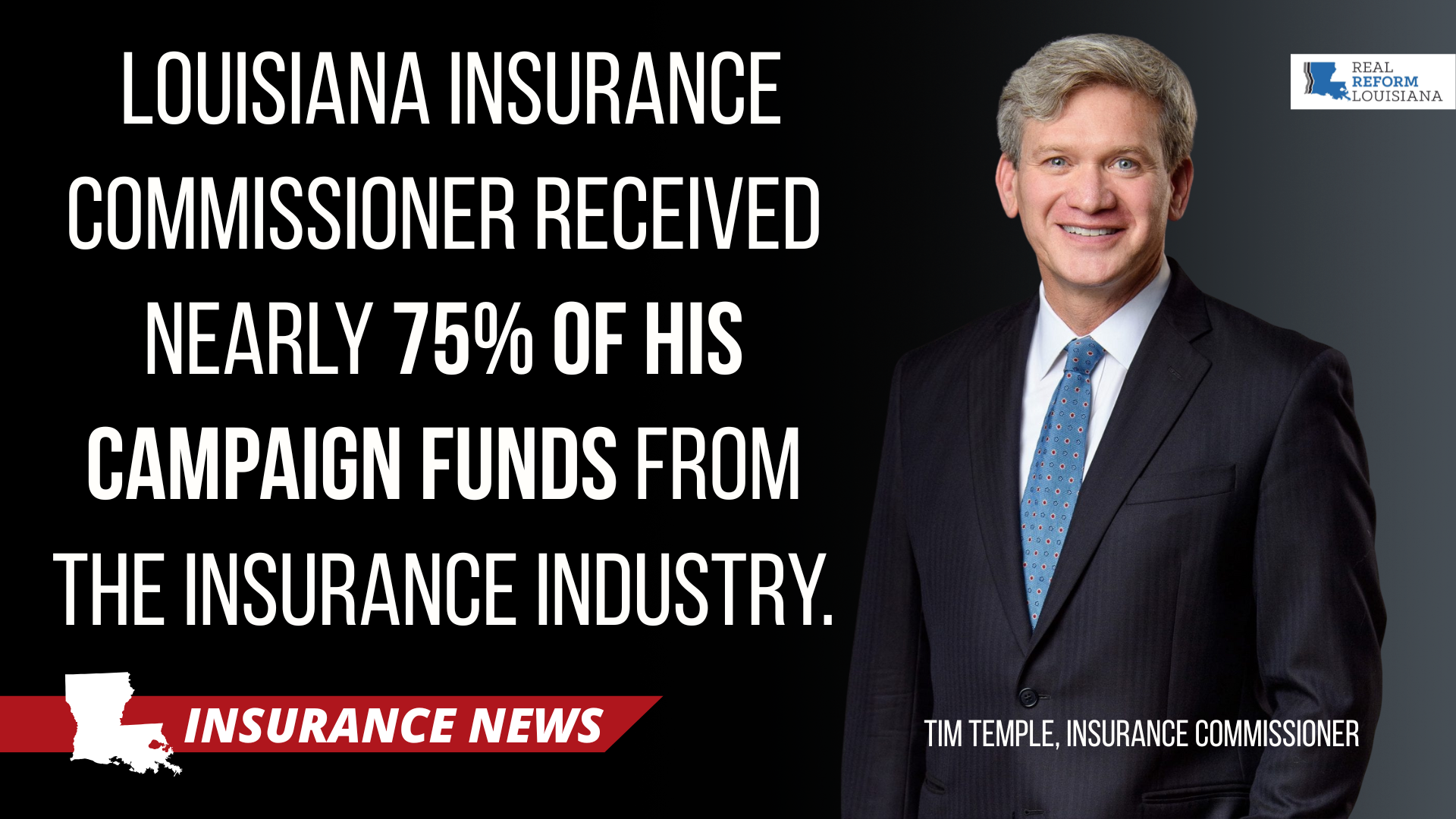
Is Louisiana in Good Hands with Commissioner Temple? Commissioner Tim Temple received nearly 75% of his campaign contributions from the insurance industry, as reported in the Advocate-Times Picayune. Commissioner Temple is a former insurance executive whose family owns an insurance company. Temple has pushed a radical anti-consumer agenda since being elected without opposition in 2023. Temple lifted profit caps for insurers, made it easier for them to raise rates, deny claims, and cancel policies —all while pushing legislation that makes it harder for Louisiana policyholders to file claims and hold insurers accountable. At the same time, insurance companies are reporting record profits. In 2024, the industry reported a 91% spike in profits, reaching a record $166.8 billion! In Louisiana, auto insurers had the third-highest profit in the country, while home insurers have reported $55 profit for every dollar lost since 2004. In short, Big Insurance has gotten its money's worth. Commissioner Temple’s job is to regulate the industry that funded his campaign. But instead of regulating insurance companies, Commissioner Temple has repeatedly pushed the industry’s agenda. Temple is regulating the people of Louisiana, making it harder for them to get claims paid and hold their insurer accountable. It’s a blatant conflict that should concern every Louisiana citizen and give pause to lawmakers following Temple off the tort reform cliff.
By Ben Riggs August 11, 2025
The body content of your post goes here. To edit this text, click on it and delete this default text and start typing your own or paste your own from a different source.
By Ben Riggs August 1, 2025
The body content of your post goes here. To edit this text, click on it and delete this default text and start typing your own or paste your own from a different source.
By Ben Riggs July 24, 2025
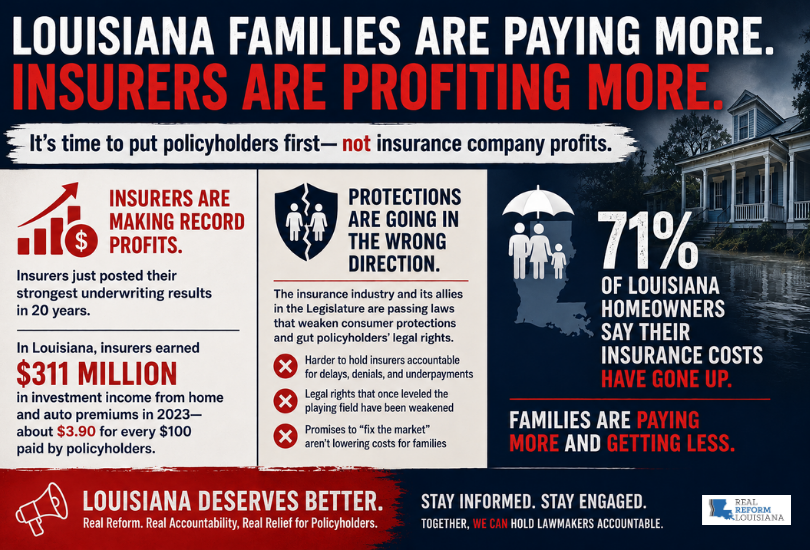
The truth about insurer profits in Louisiana. Insurance Commissioner Tim Temple is a former insurance executive whose family owned an insurance company. Temple received nearly 75% of his campaign contributions from the insurance industry. During this legislative session, Commissioner Temple has pushed a radical, pro-insurance agenda that pads insurer profits by stripping policyholders and accident victims of their rights. To advance that agenda, Commissioner Tim Temple has pushed misinformation about the profits of insurers operating in Louisiana. Here are the facts about insurer profits in Louisiana: As Warren Buffet (who owns GEICO) explains in this shareholder letter , auto insurance companies make most of their profits from investing your premium dollars, not underwriting insurance policies. Nevertheless, Louisiana was one of 18 states to make an underwriting profit, according to the most recent NAIC profitability report. Louisiana had the third-best underwriting profit nationally according to the report. But investments are where they make the big bucks: According to a recent report from Weiss Ratings , auto insurers operating in Louisiana made $1.3 BILLION in investments between 2015-2024, which comes to $5.77 for every dollar lost in underwriting. While the highest rates in the nation are a key chunk of insurers' big profits in Louisiana, another significant component is denying claims. Private passenger liability claims closed without payment has increased from 39.2% of total claims in 2015 to 45.2% in 2024, according to Weiss. The truth is BIG INSURANCE COMPANIES are raking in record profits while Louisiana families and small businesses are paying unaffordable rates and seeing their claims denied at an alarming rate.
By Ben Riggs July 24, 2025
5 Facts About Louisiana's Insurance Market. 1) High Rates: Louisianans pay the highest auto insurance premiums in the nation ($3,481 per year) and the 5th highest home insurance premiums ($4,291). - Marketwatch/Bankrate, June 2025 2) Huge Profits: Auto insurers operating in Louisiana have the 3rd highest underwriting profit in the country, meaning they charge high premiums and pay out less in claims. - NAIC, April 2025 3) $55 profits for every $1 lost: Since 2004, home insurers operating in Louisiana made $88.3 billion investing your premium dollars and reported just $1.6 billion in underwriting losses, meaning they made $55 profit for every dollar they lost. - Weiss, May 2025 4) Not paying Claims: Home insurers operating in Louisiana denied 44.6% of claims filed in 2024, which is significantly above the national average. Auto insurers denied 45.2% of private passenger liability claims in 2024. -Weiss, May 2025 5) Tort Reform Does Not Work: Rates are still high, insurers are making record profits, while denying claims at an alarming rate. It’s obvious: tort reform guts consumer protections to pad insurer profits.
By Ben Riggs July 24, 2025
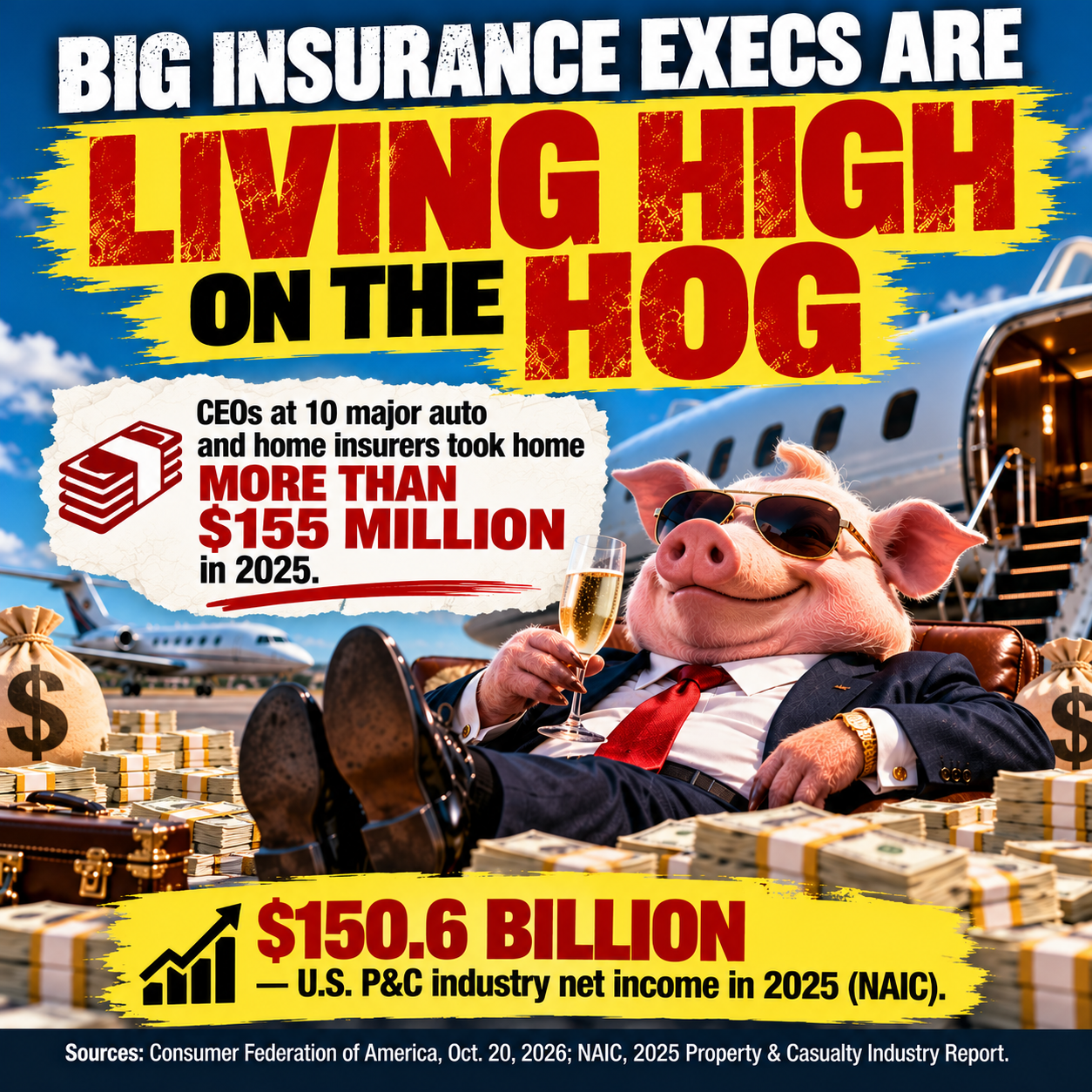
Louisiana families struggle, as corporate fat cats live high on the hog! The latest numbers are in, and they're appalling. In 2024, Property & Casualty insurers reaped a staggering $170 BILLION in profits —a 91% jump from 2023 and a jaw-dropping 330% surge from 2022! Meanwhile, their executives are rolling in dough, with 9 of the top home insurers' executives pocketing a whopping $310 MILLION in compensation. Who's footing the bill? Sadly, it is Louisiana policyholders . Louisianans pay the second-highest annual premium in the nation—with t hat number expected to rise another 27% by the end of 2025 . Nevertheless, year after year, the industry and its allies in the legislature pass tort reform laws that gut consumer protections. As a result, nearly half of all claims in Louisiana are closed without payment. Due to sky-high rates, a lax regulatory environment, and weak consumer protections, property insurers operating in Louisiana have raked in a shocking $55 in profit for every dollar they have lost over the last 20 years. Moreover, automobile insurers in Louisiana are also making out like bandits, as rates are among the highest in the nation despite auto insurers operating in Louisiana having the 3rd highest profit and some of the best loss ratios in the country. We cannot afford to sit idly by while Louisiana families and small businesses struggle to get by and these corporate fat cats live high on the hog! Tort reform does not lower rates. It pads the profits of big insurers and stuffs the pockets of executives. We must pass real insurance reforms that lower rates, hold insurers accountable, and strengthen consumer protections.